


Table of Contents
- What Makes a Curated Western Wear Boutique Different
- Bluewater Cowboy Alternative: What Shoppers Actually Get
- How to Style Western Apparel Without Looking Costumey
- Best Western Hat Brands for Women (and What Holds Up)
- Curated Western Fashion Boutiques vs. Big Online Retailers
- Capsule Wardrobe: 8 Pieces That Cover a Week of Western Outfits
- Caring for Western Materials So They Last
- Frequently Asked Questions
Last Updated: September 16, 2026
What Makes a Curated Western Wear Boutique Different
A curated western wear boutique is a small-format retailer that hand-selects a limited inventory of western-inspired apparel and accessories rather than stocking every size and style a mass catalog can carry. The difference shows up in what you don't see: fewer duplicates, more deliberate picks, and staff who can explain why a piece made the cut. At Boutique Bella Bella, that means a size-inclusive floor where a shopper can find a statement piece and the everyday basics that support it in one visit.
Bluewater Cowboy Alternative: What Shoppers Actually Get
What shoppers actually get is a smaller, more considered selection backed by in-person guidance, plus a different cost structure than a large online catalog. Instead of scrolling thousands of SKUs, you walk a floor where every piece was chosen for a reason.
Concretely, that means:
- Fit verification before purchase. You try the boot, the coat, the dress. No guessing on sizing charts, no return-label cycle.
- Styling context. Staff who pair a piece with what you already own, not just sell it to you.
- Materials you can touch. Suede, wool, cotton-linen, brass. Feel matters more than a product photo.
- Size range you can see. A size-inclusive boutique stocks the full run, not just the middle.
- A shorter decision loop. One visit replaces three weeks of tab-hopping.
What the Price Tag Actually Buys
In curated western retail, the sticker price often looks higher than a mass-market equivalent, but the cost per wear runs lower. A $119.99 suede fold-over boot worn twice a week for two seasons beats a $60 boot worn four times and abandoned.
- Does it layer with at least three things I already own? If not, it is a costume piece.
- Can I name the occasion I will wear it to in the next 30 days? If not, it is aspirational inventory.
- Would I still want it if it were the only western piece I owned? If yes, it is a foundation piece.
Where the Boutique Model Breaks Down
Curation is not automatically better. It fails when the edit skews to one aesthetic and you sit outside it, when restock is slow so a size you need never comes back, or when staff guidance is sales pressure dressed up as styling advice. The honest test is whether the floor team will tell you not to buy something.
How to Style Western Apparel Without Looking Costumey
Styling western apparel without looking costumey comes down to restraint: pick one or two western elements per outfit and let everything else stay modern. The costume effect happens when every piece signals "western" at the same volume.
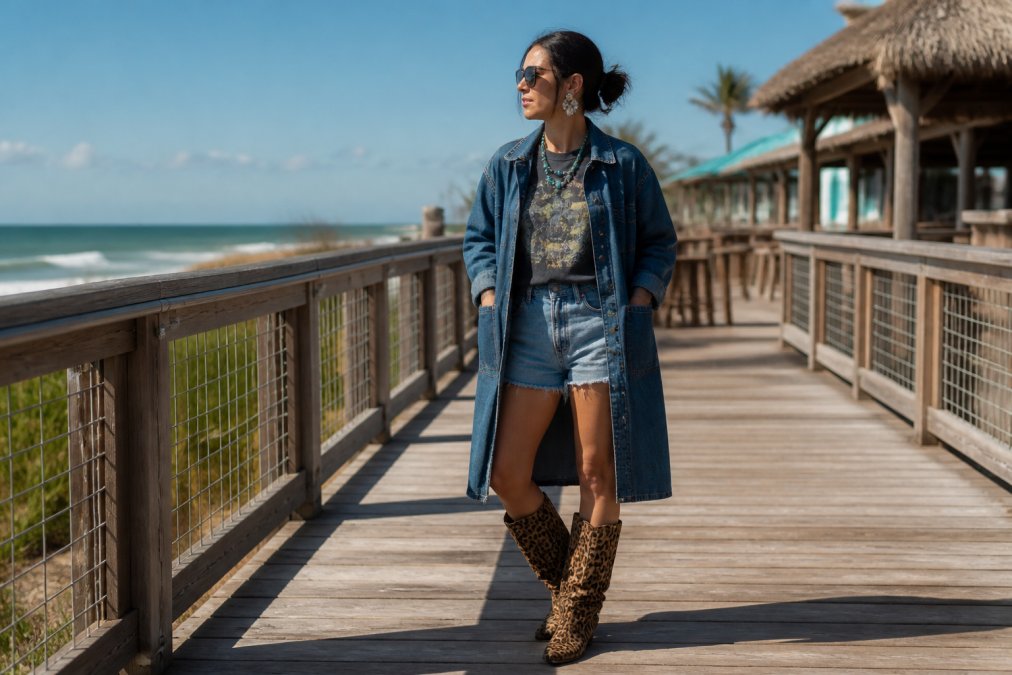
The 3-3-3 Rule for Building a Western Outfit
The 3-3-3 Rule is a styling framework: three western elements maximum, three neutral anchors, three minutes to check the mirror before you leave. It keeps a western aesthetic from tipping into dress-up territory.
Apply it like this:
| Layer | Western Elements (max 3) | Neutral Anchors (3) | Check (3 min) |
|---|---|---|---|
| Base | Western graphic tee or shirt | Plain denim, leggings, or a solid dress | Does one piece lead? |
| Outer | Denim barn coat or a western jacket | Neutral bag, simple jewelry | Is anything competing? |
| Footwear | Roper boots or cowboy boots | Belt, scarf, or bandana | Would this read at a grocery store? |
Body-Type Notes for Western Silhouettes
Western silhouettes are built on strong shoulders, defined waists, and wide hems, so fit matters more than trend:
- Shorter frames: A short cowboy boot keeps the leg line longer than a tall shaft. Fold-over styles with a pointed toe add length without height.
- Curvier builds: A structured denim barn coat creates a clean vertical line; look for a defined waist rather than a boxy cut.
- Broader shoulders: Balance a strong shoulder with a wider boot or a fuller skirt.
- Petite to tall: Hem length matters most. A maxi shirt dress should hit where it flatters, not where the size chart says.
Best Western Hat Brands for Women (and What Holds Up)
The best western hat brands for women hold their shape after a season of wear, which usually means wool felt for structure and straw for warm-weather breathability. Shape retention is the honest test: a hat that droops by month two was never worth the price. Quality craftsmanship extends beyond your wardrobe to the home, where authentic western decor styles provide a lasting aesthetic that mirrors the durability of a well-made hat.
Wool vs. Straw: Choosing by Season and Use
Choose wool felt for structure, cool-weather wear, and shape retention over years. Choose straw for breathability, summer events, and a lighter feel.
Curated Western Fashion Boutiques vs. Big Online Retailers
Curated western fashion boutiques win on fit, guidance, and material honesty; big online retailers win on selection and shipping speed. Neither is universally better. What most comparison guides skip is what matters most to a buyer investing in quality pieces: where the materials come from, what the piece costs over its life, and whether the cut works on your body.
Queen of Sparkles Royal Blue Multi →
| Factor | Curated Boutique | Big Online Retailer |
|---|---|---|
| Selection | Limited, hand-picked | Very large |
| Fit certainty | Try before you buy | Depends on returns |
| Styling help | In-person staff | None or chatbot |
| Material check | Touch and inspect | Photos only |
| Shipping | Local pickup or ship | Usually fastest |
| Size range | Full run, size-inclusive | Varies by listing |
| Sourcing transparency | Staff can often name the maker | Rarely disclosed |
| Cost per wear | Higher upfront, lower over time | Lower upfront, higher churn |
The Sourcing Question Nobody Asks
Most western wear coverage stops at style and price. The gap is sourcing. Leather, wool, and cotton have very different supply chains, and a boutique that can tell you where a hide was tanned or who made a hat gives you information a warehouse listing almost never provides.
- Ask who made it. A boutique that stocks small-batch makers usually knows the name. A mass listing usually does not.
- Look at the tag, not the marketing. Fiber content and country of origin are required disclosures on apparel sold in the United States (the FTC). If a listing buries them, that is a signal.
- Check for repair or resole options. A boot that can be resoled has a longer life than one that cannot.
- Prefer natural fibers when longevity matters. Wool felt, full-grain leather, and cotton-linen blends age better than synthetic blends.
Total Cost of Ownership, Not Sticker Price
A $119.99 suede boot resoled once over three years costs less per wear than a $60 boot replaced twice. The same logic applies to a $169.99 wool felt hat that holds its crease versus a $45 straw hat replaced every summer.
Fit by Body Type, Not by Size Chart
Western cuts are built on strong shoulders, defined waists, and wide hems, so the size chart is a starting point, not an answer. A boutique lets you test the cut on your frame; a warehouse makes you guess.
Capsule Wardrobe: 8 Pieces That Cover a Week of Western Outfits
A western capsule wardrobe is eight pieces that mix into at least seven distinct outfits without repeating a full look. The formula works because western pieces are naturally interchangeable: boots work with denim, dresses, and skirts; a barn coat layers over all of it.
The eight pieces:
- One pair of western boots. The Pamela Fold Over Boots Leopard ($119.99) in soft suede with a pointed toe and 2.5-inch stacked heel cover both casual and dressed-up.
- One statement boot. The Queen of Sparkles Royal Blue Multi Cowboy Boot Short ($44.45) handles festivals, dancing, and anything that needs personality.
- One denim barn coat. The Wildcat Denim Barn Coat ($79.99) layers over denim, leggings, or a dress.
- One graphic tee. The Howdy Glam Skull 3D Jewels Tee ($54.99) carries the western aesthetic on its own.
- One maxi shirt dress. The Contrast Western Style Graphic Print Maxi Shirt Dress ($209.99) in a cotton-linen blend works for casual or dressed-up wear.
- One bolo tie. Western Bolos ($24.95) add flair without committing to a full western look.
- One statement necklace. The Texas Domino Turquoise Necklace ($64.99) has a double-sided resin pendant, turquoise bead chain, and a Texas flag motif on the reverse.
- One bandana ring. The Harper Horseshoe Bandana Ring in brass ($39.99) locks a scarf or doubles as a size 8 ring.
Caring for Western Materials So They Last
Caring for western materials comes down to three habits: keep leather and suede dry, store accessories away from moisture, and never let a wool hat sit crushed. Most premature wear is a storage problem, not a quality problem.

- Suede and leather: Brush suede after wear, keep it away from direct heat, and let it dry naturally if it gets wet. Never use a radiator.
- Wool felt hats: Store on a hook or in a hat box, brim-side down or supported. Crushing is what kills the shape.
- Brass and plated jewelry: Store in a dry place. The Harper Horseshoe Bandana Ring is lacquer-coated brass, and the Black Enamel Cowboy Hat Necklace is water and tarnish resistant, but neither benefits from a humid drawer.
- Cotton-linen garments: Wash cool, hang dry, and accept a wrinkle or two.
Frequently Asked Questions
What is the 3-3-3 rule for clothing?
The 3-3-3 rule keeps an outfit from looking chaotic: three colors, three textures, and three focal points at most. In western styling, that might mean denim, cream, and turquoise; leather, suede, and cotton; and one hat, one necklace, and one boot. Limiting each category stops a western look from tipping into costume territory, because the eye has somewhere to rest.
How do I find high-quality western wear that doesn't look like a costume?
Buy fewer pieces and look at construction. Then anchor the outfit with one authentic piece, such as a handmade wool cowboy hat, and keep the rest of the look modern: dark denim, a plain tee, and simple jewelry. One heritage item plus everyday basics reads intentional, not theatrical.
What are the best alternatives for curated western hats and accessories?
Instead of a single big-box source, build a small rotation: one wool felt hat for cool weather, one straw hat for summer, a bolo or turquoise necklace for statement days, and a bandana ring for subtle western detail. Shopping a curated western wear boutique means each piece is chosen to work with the others, so you avoid the mismatched look that comes from grabbing whatever is on sale.
Is western fashion still trending for everyday wear in 2026?
Yes, but the trend has shifted from full rodeo looks to western-inspired accents worn with regular clothes. Fold-over boots, barn coats, and graphic tees with western motifs are the pieces doing the heavy lifting now. The practical version of the trend is what lasts: a western silhouette in one or two pieces, styled with denim and basics you already own.
How can I style western pieces for a modern, sophisticated look?
Choose one western element per outfit and let the rest stay quiet. A short cowboy boot with a midi dress, a denim barn coat over leggings and a plain top, or a turquoise necklace with a white button-down all work because the western piece is the accent, not the whole story. Keep colors to two or three, and skip matching head-to-toe western motifs.