


Last Updated: October 28, 2026
Quick Summary
Define your signature fashion aesthetic by auditing your closet first, then tracking what you actually wear for two weeks. Build repeatable outfit formulas from the colors, silhouettes, and textures you already reach for, and change one lever at a time as your life shifts.
- Sort your closet into three piles: love and wear, maybe, and let go.
- Track outfits for 14 days and count repeats to find your real staples.
- The 3-3-3 rule means three colors, three textures, and three accessories.
- Preserve two of your three core levers and change the third as life changes.
- A $15-$30 alteration often does more for a garment than a new purchase.
Table of Contents
- Start With a Wardrobe Audit, Not a Shopping Spree
- How to Find Your Signature Style by Studying What You Already Reach For
- Fashion Aesthetic Types: Finding the One That Fits Your Personality
- Build Outfit Formulas Around Your Body Shape and Proportions
- The 3-3-3 Rule in Fashion: A Simple Framework for Getting Dressed
- Signature Look Outfit Ideas You Can Build From Your Curated Closet
- Style Evolution, Budget, and the Psychology Holding You Back
- Book a Try-On Session at Boutique Bella Bella
- Frequently Asked Questions
Start With a Wardrobe Audit, Not a Shopping Spree
You want to know how to define your signature fashion aesthetic, and the answer starts in your closet, not a checkout cart. A signature fashion aesthetic is the repeatable visual identity that makes your outfits recognizable, built from specific colors, silhouettes, textures, and accessories you return to again and again.
Before you buy a single new piece, audit what you have. That audit is the foundation of everything that follows.
The Three-Pile Sort
Set aside two hours and empty your closet onto the bed. Sort every item into three piles:
- Love and wear: it fits, flatters, and you reach for it
- Maybe: it fits but you never choose it
- Let go: wrong size, worn out, or never worn
Be honest with the maybe pile. If you have not worn it in a year, it belongs in let go.
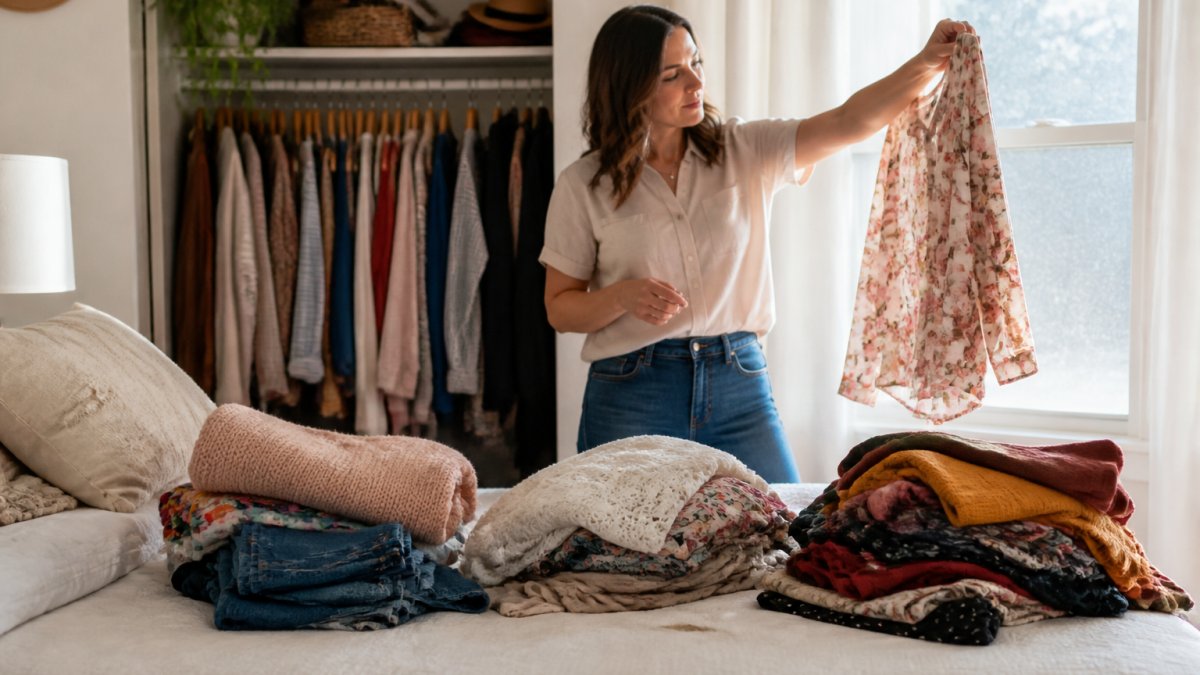
What Your Closet Is Already Telling You
Your closet holds the answer to how to find your signature style before you open a browser tab. Look for patterns in the love pile: five versions of the same white tee, three pairs of wide-leg denim, a drawer of gold chains.
A common mistake is treating the audit as a decluttering chore. It is really a data-gathering exercise. Note the colors, fabrics, and shapes that dominate your keep pile. That shortlist becomes your style guide.
How to Find Your Signature Style by Studying What You Already Reach For
Forget the style quiz. Track what you actually wear for two weeks, your daily habits can help you reflect on your preferences.
Try this tracking method:
- Keep a notebook by your closet for 14 days
- Write down each outfit and how it made you feel
- Mark the pieces you wanted to take off by noon
At the end, count the repeats. The pieces you wore three or more times are your wardrobe staples, not a passing trend. Build around them first.
Fashion Aesthetic Types: Finding the One That Fits Your Personality
The main fashion aesthetic types fall into a few broad camps: classic, minimalist, bohemian, coastal, Western, maximalist, and romantic. Most people are a blend of two or three.
A common mistake is choosing an aesthetic from a mood board instead of your own behavior. Mood boards show you what you admire; your daily life shows you what you will actually wear.
Matching Personality Traits to Visual Consistency
Your personality traits should drive your aesthetic, not the other way around. Each trait points to a visual lever, and repeating that lever across outfits creates visual consistency:
- Bold and social: high-contrast color blocking, statement hardware (oversized links, bold buckles), glossy finishes like satin or patent leather, and one focal accessory per outfit. The lever is contrast, keep one element loud and the rest quiet so the look reads as intentional rather than chaotic.
- Grounded and practical: matte textures (canvas, denim, brushed leather), neutral or earth-tone palettes, and functional details like patch pockets and sturdy stitching. The lever is texture, vary matte surfaces so the outfit has depth without needing print or shine.
- Free-spirited: flowing silhouettes, mixed natural fibers (linen with cotton, silk with wool), and layered jewelry in mixed metals. The lever is movement, choose pieces that shift when you walk so the outfit reads as relaxed rather than sloppy.
Visual consistency comes from repeating your chosen elements. A useful test: lay out three outfits you love and circle every element that appears in at least two. Those circled elements are your real aesthetic, the labels are just shorthand for them.
The Trait-to-Fabric Translation
Personality traits are abstract; fabric is what you actually buy. Translate each trait into a fabric and a finish before you shop:
- Outgoing → satin, sequin, patent leather, bold hardware
- Calm → cotton poplin, merino, brushed twill, matte gold
- Creative → mixed fibers, raw hems, artisan prints, mixed metals
Write your three traits in a notebook and list the fabrics and finishes next to them. That short list becomes your shopping filter, if a piece does not match at least one trait, it is probably a trend purchase rather than a signature purchase. This is the step most style quizzes skip, and the one that keeps your aesthetic consistent from season to season.
Build Outfit Formulas Around Your Body Shape and Proportions
An outfit formula is a repeatable combination that works for your body every time, removing the morning guesswork. Start with your proportions, not trends. If you love high-waisted wide-leg denim, your formula might be a fitted tank tucked in, a wide leg, and a chunky chain, volume on the bottom, a clean line on top.
A few formula starters:
- Fitted top + wide-leg denim + statement necklace
- Flowy dress + cropped trench + simple studs
- Tank + tailored trousers + layered gold chains
The 3-3-3 Rule in Fashion: A Simple Framework for Getting Dressed
The 3-3-3 rule in fashion is a fast way to build a complete look: three colors, three textures, and three accessories. It forces balance, too few elements look flat, too many look chaotic.
Here is one way to use it:
- Three colors: a charcoal base, a denim blue, and a gold accent
- Three textures: cotton, denim, and metal
- Three accessories: a chain necklace, small studs, and a belt
Run the rule a few times and it becomes automatic, your own combinations form without a mirror check.
Signature Look Outfit Ideas You Can Build From Your Curated Closet
Your curated closet should produce outfits on demand. Build two or three signature looks you can rotate all season, each using pieces you already love plus one or two accents that make it yours. Here are two directions to try.
Coastal Statement: Studs, Sequins, and Sun
This look leans into shimmer and ease. For a deeper guide to assembling a coastal capsule wardrobe, see The Complete Guide to Building a Coastal Capsule Wardrobe. Pair the Charcoal Rocker Tank with the Vintage Bloom Leopard Wide Leg Denim, then add the Chunky Chain Necklace for a bold finish. The studs and the denim print carry the texture; the gold chain ties it together.


Western Refined: Denim, Leather, and a Good Hat
This look softens Western style for everyday wear. Start with denim and leather, then add a hat that holds its shape. For a checklist of modern boutique staples to build around, see Must-Have Western Boutique Staples for a Modern Wardrobe. If you are wondering how to pair jewelry with a Western hat, see How Do You Match Jewelry With a Western Hat?.
Style Evolution, Budget, and the Psychology Holding You Back
Your style will change as your life changes, that is normal, not a failure. Three forces quietly hold a signature style in place: life-stage shifts, budget constraints, and the fear of being seen.
Style Evolution Through Life Stages
A signature aesthetic is not a costume you lock in at 25. It is a set of levers you adjust as your life changes, change the lever, not the whole wardrobe:
- Career change: If you move from a creative role to a client-facing one, keep your palette and swap one lever, trade the statement sneaker for a structured loafer, or the graphic tee for a crisp poplin. Your aesthetic stays recognizable; the formality dial moves.
- Parenthood: Keep the silhouette and change the fabric. Washable fibers (cotton, merino, technical blends) and flat shoes preserve the look while surviving the day.
- Aging: Keep the color story and adjust the contrast. The lever is contrast, not coverage.
The pattern is consistent: preserve two of your three core levers (color, silhouette, texture) and change the third. That is how a signature survives a life stage without becoming a time capsule.
Building a Signature on a Budget
You do not need a big budget to build a signature, just focus and a willingness to alter what you already own. The budget-conscious path can go further:
- Tailoring: A $15-$30 alteration (hems, waist take-in, sleeve shortening) often does more for a garment than a new purchase. Most dry cleaners and local tailors offer hemming in this range; a waist take-in typically runs somewhat higher. Tailoring is the highest-return spend in a signature wardrobe because it makes existing pieces fit like they were made for you.
- Thrifting and resale: Secondhand is where you test a new lever cheaply. If you want to try a Western or coastal direction, buy one secondhand piece before committing to a full-price version. Resale platforms and local shops let you experiment for a fraction of retail.
- Spend where it shows: Put budget into the pieces that anchor an outfit, a standout trench, a hat you will wear for years, a statement necklace. The Bold Bloom Luxe Trench is a good example of one piece doing most of the work in an outfit.
The Psychology Holding You Back
Naming the barrier is the first step; the second is a concrete exposure plan:
- Fear of standing out: Add one statement accessory to an otherwise familiar outfit and wear it on a low-stakes errand. Repeat until the accessory feels normal, then add a second element. Confidence is built through repetition, not through a single bold purchase.
- Fear of wasting money: Set a return window rule, buy only from retailers with a clear return policy, and decide within seven days. The rule lowers the cost of a wrong choice, which makes experimentation feel safer.
- Fear of getting it wrong: Treat your first three outfits as drafts, not finals. Photograph them, note what felt off, and adjust one element the next time.
The goal is not to eliminate the fear, it is to make the next small step easier than the last.
Slow Fashion and Intentional Shopping
Slow fashion means buying less and choosing better. Intentional shopping starts with a list made during your wardrobe audit, not during a sale. Before you buy, ask:
- Does it work with at least three pieces I already own?
- Does it fit my color palette?
- Will I still want it next year?
If the answer is no to any of these, leave it on the rack.
| Barrier | Fix | What Changes |
|---|---|---|
| Closet full, nothing to wear | Three-pile audit | Clear view of real staples |
| No idea what suits you | Two-week wear tracker | Patterns you can trust |
| Outfits feel random | 3-3-3 rule | Consistent, styled looks |
| Overspending on trends | One quality piece per season | Fewer, better purchases |
| Fear of standing out | One statement accessory, repeated | Confidence built slowly |
| Life stage shifted | Change one lever, keep two | Signature survives transitions |
| Tight budget | Tailor, thrift, upcycle | Fit without full-price spend |
Book a Try-On Session at Boutique Bella Bella
Defining your signature fashion aesthetic is easier with a second set of eyes and a room full of pieces to try. Our size-inclusive boutique carries statement apparel, jewelry, and accessories you can touch, layer, and test in person before you commit. We will help you sort your palette, build outfit formulas around your shape, and find the pieces that make your signature look unmistakably yours.
Get started with Boutique Bella Bella and stop in to explore the styles that fit your personal style.
Frequently Asked Questions
What is the 3-3-3 rule in fashion?
The 3-3-3 rule in fashion is a styling shortcut: three colors, three textures, and three accessories in one outfit. It keeps a look visually interesting without tipping into chaos. Pick a base color, a secondary color, and one accent, then mix three fabrics (denim, cotton, leather, for example) and finish with three accessories such as a necklace, belt, and bag. It works especially well when you are building a signature fashion aesthetic because it forces consistency across outfits.
How do I find my signature style when my taste keeps changing?
Start by tracking what you wear three or more times in a month, not what you admire on other people. Photograph those outfits and look for patterns: a color palette, a silhouette, a fabric. Then consider how those patterns relate to your style.
What are the main fashion aesthetic types?
Most fashion aesthetic types fall into a handful of families: minimalist, classic, romantic, bohemian, streetwear, western, coastal, and maximalist. Many people blend two. A coastal aesthetic might mix linen and denim with statement jewelry, while a western aesthetic leans on boots, hats, and structured denim. The goal is not to pick one label forever, but to identify the two or three that match your personality traits and the clothes you already reach for.
How do I build a signature look on a budget?
Build around pieces you already own, then consider adding an anchor item. The Chunky Chain Necklace is $24.99, and the Bold Bloom Luxe Trench is $62.99. Shop intentionally and consider how a piece works with what you own.
Your style is already in your closet. It just needs a framework. Let us help you find it, one piece at a time.
