


Table of Contents
- Start With a Strong Base Necklace
- Best Necklace Lengths for Layering
- How to Mix Metals in Your Jewelry Stack
- Layering Statement Jewelry With Different Necklines
- How to Prevent Necklaces From Tangling
- Styling Statement Jewelry for Different Occasions
- Common Mistakes to Avoid When Layering
- Frequently Asked Questions
Last Updated: September 19, 2026
Start With a Strong Base Necklace
The foundation of any great layer statement jewelry stack is choosing the right base necklace. At Boutique Bella Bella, we recommend starting with a piece that has presence but doesn't fight with other necklaces.
Your base necklace should be substantial enough to anchor the look. A delicate chain disappears when you add layers; a bold statement piece gives your entire stack direction.
Consider the Layered In Pearls Necklace from our collection. Multiple strands of lustrous pearls create dimension and movement, making it ideal as a base layer or worn solo. With a sturdy leather closure, it's ready for layering and transitions seamlessly from day to night.

The best base necklaces have visible texture or beading, a secure clasp, length between 16-18 inches, and weight that sits properly against your collarbone. Avoid thin, delicate chains, they disappear under heavier pieces and create visual clutter.
Best Necklace Lengths for Layering
The ideal necklace lengths for layering are 16, 18, and 20 inches, though this varies based on your neck shape, collarbone structure, and torso proportions.
Standard Length Guidelines
| Length | Placement | Effect |
|---|---|---|
| 16 inches | Choker to collarbone | Sits closest to neck, creates framing |
| 18 inches | Collarbone to upper chest | Mid-layer, bridges short and long |
| 20 inches | Chest to mid-sternum | Longest visible layer, adds drama |
| 22+ inches | Below sternum | Works for open necklines only |
A 16-inch choker sits at your collarbone, an 18-inch piece hits the collarbone, and a 20-22 inch piece extends to the chest.
Adjusting for Neck Shape and Length
Short neck or high collarbone: Start at 17-18 inches instead of 16, with middle layer at 19-20 inches and longest piece at 21-23 inches to elongate your neck.
Long neck or low collarbone: Use 15-inch, 17-inch, and 19-inch pieces to fill the space proportionally.
Broader shoulders and chest: Use longer necklaces (20-24 inches); start at 18 inches minimum for your base layer.
Petite frame: Use shorter necklaces (14-16, 16-18, 18-20 inches) to avoid being overwhelmed by long chains.
The Spacing Rule
Jump by at least 2 inches between each necklace to create clear visual separation. If your base is 16 inches, your next layer should be 18 inches minimum, then 20 inches or longer.
Finding Your Personal Sweet Spot
Layer three necklaces you already own and photograph yourself to find your ideal lengths. Use balanced lengths as your template for future purchases.
How to Mix Metals in Your Jewelry Stack
Mixing metals is now standard for layer statement jewelry, the key is intentional mixing, not accidental chaos.
Layer gold, silver, rose gold, and copper by choosing metals that share similar undertones or commit to bold contrast.
Warm metals together: Gold, rose gold, and copper play well together. They share warm undertones that complement each other naturally.
Cool metals together: Silver, white gold, and platinum create a cool, sophisticated stack.
Bold contrast: Mix warm and cool metals deliberately. A gold statement piece with silver chains creates intentional visual interest, not accidental mismatch.
The Chunky Crystal Clear Necklace from Boutique Bella Bella comes in gold, making it a warm-toned anchor piece that pairs beautifully with rose gold or copper accents. This 16-inch piece with a 3-inch extender gives you flexibility in how you layer it.

Stick to two or three metal tones maximum; more looks scattered.
Layering Statement Jewelry With Different Necklines
Crew necklines: Keep pieces between 16-18 inches; longer necklaces get lost against the shirt.
V-necklines: Use 18-22 inches; the V creates visual space for graduated lengths.
Off-shoulder and open necklines: Use longer necklaces (20-24 inches); shorter pieces look awkward in open space.
Turtlenecks and high necklines: Stick to one statement piece or keep everything short and delicate, 16 inches maximum.
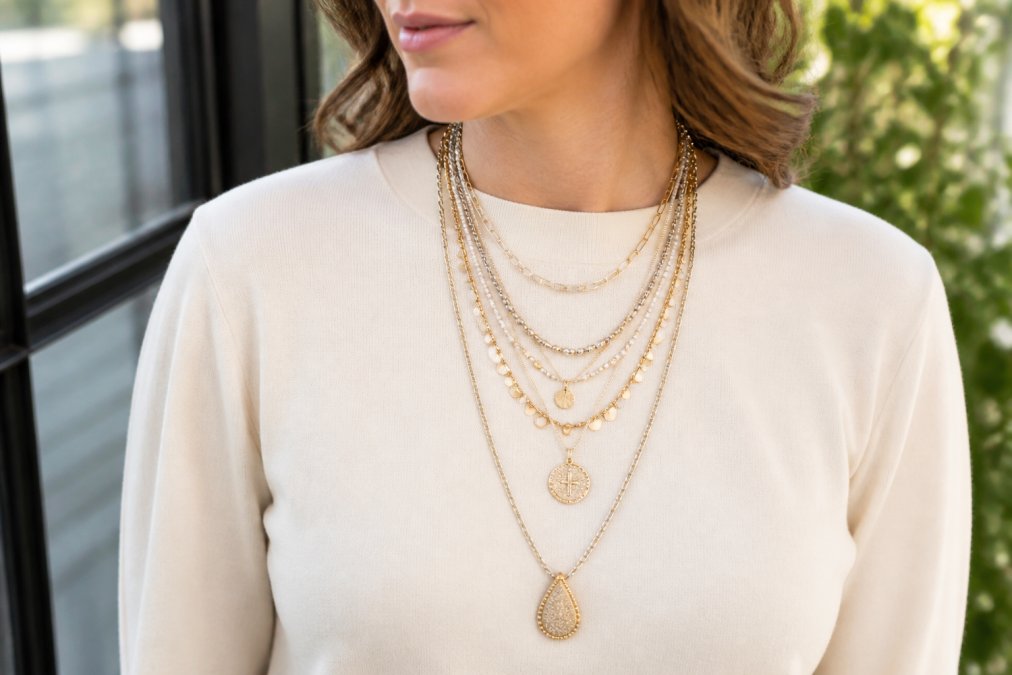
The Grand Pearl Drape Collar from our collection works beautifully over open necklines. Its dramatic silhouette and cascading beaded fringe create movement that requires space. Pair it with a minimalist ensemble to let the statement piece shine.

How to Prevent Necklaces From Tangling
Tangling is the biggest frustration with layered necklaces because different chain textures and weights naturally catch on each other. Prevention and a reliable untangling system solve this.
Chain Types That Resist Tangling
Chains that tangle easily (avoid pairing together):
- Curb chains (flat interlocking links catch on each other)
- Figaro chains (mixed link sizes create snag points)
- Twisted chains (the spiral texture grabs other chains)
- Rope chains (the braided structure locks with similar chains)
Chains that resist tangling (safe to pair):
- Snake chains (smooth, uniform surface slides past other chains)
- Box chains (clean, geometric links don't catch)
- Cable chains (simple round links are less prone to snagging)
- Paperclip or elongated link chains (the shape prevents interlocking)
Non-chain pieces that prevent tangling:
- Beaded necklaces (solid beads act as buffers between chains)
- Pearl strands (pearls create natural spacing)
- Pendant necklaces with substantial pendants (the weight and size separate chains)
- Collar-style necklaces (rigid structure prevents movement and tangling)
The mixing strategy: Use different chain types in your stack. Pair a curb chain with a snake chain (they slide past each other), and add a beaded or pendant piece for maximum separation.
Fastening Order and Clasp Management
Wear necklaces in the right order: Put on your shortest necklace first, then add longer pieces to prevent tangling as you fasten each clasp.
Check your clasps before layering: Ensure every piece closes securely and the clasp sits flat against your skin. A clasp that doesn't sit flush will rotate throughout the day, causing chains to wrap around each other.
Use a clasp detangler or small hook: If you're wearing multiple delicate chains, use a small hook or clasp detangler (available at jewelry supply stores for $3-8) to hold each necklace in place while you fasten the next one. This prevents pieces from sliding and tangling as you're getting dressed.
Storage Systems That Actually Work
How you store necklaces between wears matters as much as how you wear them.
Untangling Techniques for Persistent Knots
Despite prevention, tangles happen. Having the right tools and technique saves your necklaces from damage.
Quick Daily Habits to Minimize Tangling
- Fasten your necklaces before putting on clothing. Fabric friction causes chains to twist and tangle.
- Check your necklaces before bed. If you notice any twisting or tangling, gently straighten them before sleeping. Movement during sleep causes knots to tighten.
- Avoid layering more than three delicate chains. Each additional chain increases tangle risk exponentially. If you want more pieces, use beaded or pendant necklaces instead of chains.
- Keep a small untangling kit with you: A fine-tooth comb, small hook, and travel-size bottle of baby oil fit in a small pouch. For persistent tangles on the go, apply oil, wait a few minutes, and gently work the knot loose.
Styling Statement Jewelry for Different Occasions
Statement jewelry layering changes based on where you're going. A work outfit needs restraint. A night out can be bold and dramatic.
Common Mistakes to Avoid When Layering
Most people make the same mistakes when they start layering necklaces. Knowing what to avoid saves you time and frustration.
Frequently Asked Questions
What is the best way to layer statement jewelry without looking cluttered?
Start with one focal point statement piece and build around it with thinner, shorter layers. Use the principle of mixing texture and length: pair a chunky pendant at 18 inches with delicate chains at 16 and 14 inches. This creates visual interest without overwhelming your neckline. The key is balancing scale and proportion so each piece has breathing room and your eye can follow the jewelry stack naturally.
Can you mix metals when layering statement jewelry?
Yes, mixing metals is a modern styling technique that adds depth to your look. Gold, silver, rose gold, and mixed metals work together when you repeat them throughout your stack. For example, pair a gold statement necklace with silver chains and a rose gold pendant. The repetition creates cohesion even though the metals differ. Make sure your statement piece anchors the look so the mixed metals feel intentional rather than accidental.
How do I choose the right necklace lengths for layering?
The most flattering layering uses varied lengths to prevent necklaces from stacking directly on top of each other. Shorter choker-length pieces sit closest to your collarbone, while longer pieces drape toward your chest. Consider your neck shape and neckline when selecting lengths. Taller frames can carry longer pieces, while petite frames benefit from shorter layers that don't overwhelm the silhouette.
Is layering necklaces still in style in 2026?
Absolutely. Jewelry layering has evolved from a trend into a core styling technique. Modern layering emphasizes intentional mixing of textures, scales, and metals rather than simply stacking identical chains. Statement pieces like the Grand Pearl Drape Collar or Layered In Pearls Necklace are designed specifically for this purpose, giving you versatility to wear them solo or as part of a curated stack. The key is quality pieces that balance one another.
Layering statement jewelry takes practice, but it gets easier once you understand the basics. Start with a strong base necklace, choose complementary lengths, and mix textures intentionally. At Boutique Bella Bella, we carry pieces designed for layering, from the lustrous Layered In Pearls Necklace to the dramatic Grand Pearl Drape Collar. Visit us to find statement pieces that work together beautifully and create the layered look you've been wanting to master.