


Table of Contents
- Why Coastal Style Works So Well in a Small Bathroom
- Coastal Bathroom Colors That Open Up Tight Rooms
- Small Bathroom Vanity Ideas That Actually Fit
- Floating Bathroom Vanity for Small Bathroom: Pros, Cons, and Installation
- Small Bathroom Storage Ideas That Keep the Coastal Look Clean
- Materials, Mirrors, and Lighting: Finishing the Coastal Vanity
- Budget, Moisture, and Installation Trade-Offs to Know Before You Buy
- Frequently Asked Questions
Last Updated: October 16, 2026
Why Coastal Style Works So Well in a Small Bathroom
Coastal bathroom vanity ideas for small spaces work because the style is built on light, reflection, and open sightlines, the qualities that make a tight room feel bigger. At Boutique Bella Bella, we hear it constantly: a bathroom that feels bright and breezy never feels cramped.
The formula: pale surfaces bounce light into corners dark finishes swallow, natural textures like light wood and woven jute add warmth without visual weight, and a low-profile, wall-mounted vanity keeps the floor reading as continuous.
Light, Air, and the Illusion of Space
Small bathrooms fail visually for one reason: heavy, dark elements stacked on each other. A bulky cabinet, solid mirror, and deep paint color crowd the eye before you step inside.
Coastal design flips that with three moves:
- Light color palettes on walls, floors, and the vanity itself
- Reflective surfaces like glass and polished metal that spread light around
- Open or floating elements that let the eye travel underneath and past
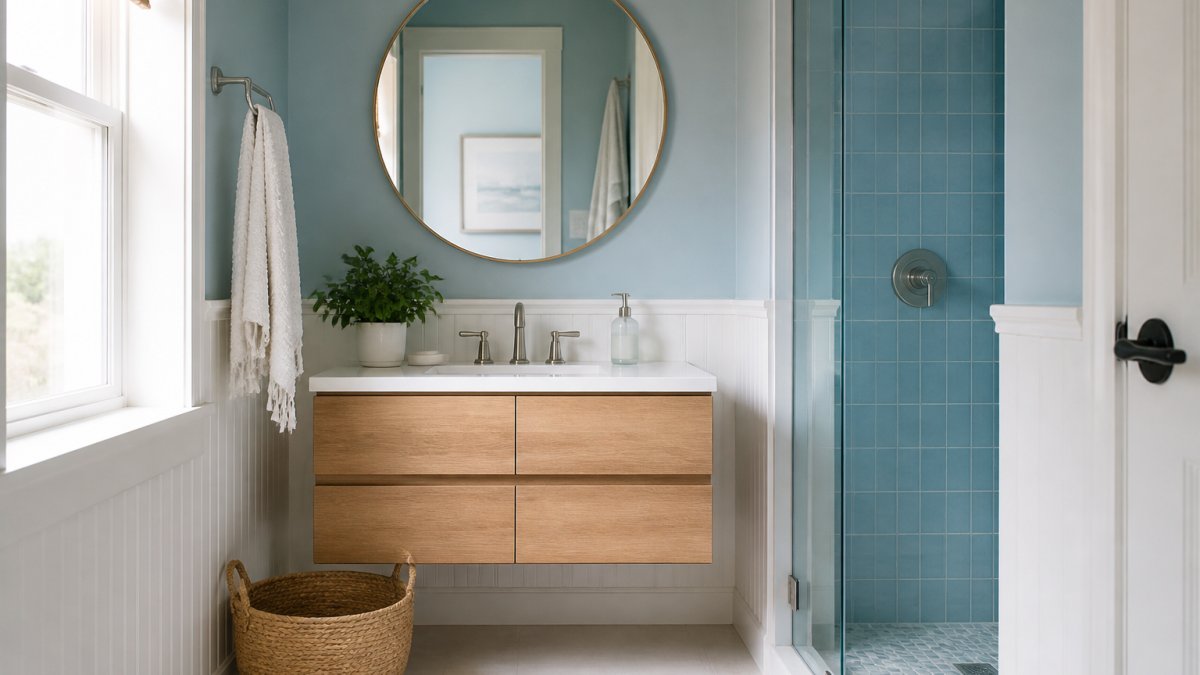
Coastal Bathroom Colors That Open Up Tight Rooms
The best coastal bathroom colors for small spaces are soft, low-contrast shades: warm white, sand, sea glass, and pale blue. They reflect light instead of absorbing it, so the room stays bright even with one small window.
High contrast is the enemy. A dark navy vanity against white walls looks striking in a large bathroom but chops a compact one into pieces. Keep your palette within two or three steps and the room reads as one continuous surface.
White, Sand, Sea Glass, and Soft Blue Palettes
Here is how we would build a palette that stays coastal without turning flat:
- Base: warm white or soft sand on walls and ceiling
- Anchor: light wood or painted white on the vanity cabinet
- Accent: sea glass green or soft blue on a towel, tray, or piece of decor
- Metal: brushed brass or warm nickel on hardware and fixtures
That last point matters: cool chrome reads clinical in a small space, while warm metals soften the room and tie into the sun-washed coastal feel.
Small Bathroom Vanity Ideas That Actually Fit
The biggest mistake we see in small bathroom vanity ideas is buying for looks before measuring for fit. A vanity that blocks the door swing or leaves no knee room is a daily frustration, however good it looked online.
Start with the numbers, then shop the style.
Vanity Dimensions and Clearances for Tight Spaces
Standard clearances exist for a reason. Check these before you buy:
| Space | Recommended Minimum | Why It Matters |
|---|---|---|
| Walkway in front of vanity | 30 inches (21 inches absolute minimum) | Lets you stand, bend, and open drawers |
| Vanity width | 24-30 inches for a single sink | Fits a basin without crowding the counter |
| Vanity depth | 18-21 inches | Keeps the room from feeling pinched |
| Space between sink and side wall | 4 inches | Prevents elbow-bumping |
| Distance from toilet to vanity | 15 inches | Required for comfortable use |
If your room genuinely cannot fit a 24-inch vanity with proper clearance, a corner configuration or a wall-mounted option with no cabinet depth is the honest answer, not a smaller cabinet crammed into the same footprint.
Single-Sink, Corner, and Narrow Configurations
Three configurations solve most tight-room problems:
- Single-sink narrow vanity (24-30 inches wide): The default choice for most small bathrooms. One basin, one drawer stack, clean lines.
- Corner vanity: Uses dead space that a straight run cannot. Best when the door and toilet leave you a corner to work with.
- Pedestal or console sink: No cabinet at all, maximum floor visibility. You trade storage for openness, so plan a wall shelf or basket nearby.
Floating Bathroom Vanity for Small Bathroom: Pros, Cons, and Installation
A floating bathroom vanity for small bathroom layouts is often the best space-saver: removing the cabinet base opens visible floor area, and that open floor reads as square footage even when the room has not gained an inch.
The catch is installation. Wall-mounted vanities need blocking or heavy-duty brackets anchored into studs, and plumbing must be roughed in behind the wall rather than dropping through a cabinet, often a dealbreaker in a rental.
Wall-Mounted vs. Freestanding: Which Saves More Floor Space?
| Feature | Wall-Mounted (Floating) | Freestanding |
|---|---|---|
| Floor space saved | High: open floor underneath | Low: cabinet sits on floor |
| Storage capacity | Usually less | Usually more |
| Installation difficulty | Higher: needs wall blocking | Lower: sits in place |
| Renter-friendly | No | Yes |
| Best for | Small rooms where openness matters most | Rooms needing maximum storage |
Our take: if you own the home and the walls can take it, go floating. If you rent, or you need every inch of storage, a freestanding narrow vanity with legs is the smarter call.
Small Bathroom Storage Ideas That Keep the Coastal Look Clean
Swapping a full-depth cabinet for a floating or narrow vanity costs cubic feet of storage, and most coastal styling guides never say where that volume goes. Plan storage by household and bathroom use before you buy the vanity, not after.
Plan Storage by Household and Bathroom Use
Count what actually lives in the room, sort it into four buckets, and give each a home off the countertop:
- Daily grooming (toothbrush, razor, daily skincare): one shallow drawer or a wall-mounted cup holder. This is the only category that earns counter space.
- Weekly and occasional (hair tools, first-aid, backup toiletries): a deep drawer or a lidded basket on open shelving.
- Bulk backup (extra toilet paper, refills, cleaning supplies): a medicine cabinet, a tall narrow cabinet, or a stacked basket tower. This is the volume a floating vanity removes, so it needs a dedicated replacement.
- Guest and decor (rolled towels, candles, shells): open shelving, a tray, or a hook, where visibility is the point.
A single adult with a hall closet nearby can run a floating vanity with one drawer and a basket. A family sharing one bathroom usually cannot, two adults and two children typically need a medicine cabinet plus a closed storage tower to replace what a 30-inch freestanding cabinet held. Match the plan to the household, not the photo.
Small Ceramic Resin Trays - Ocean Vibes →
How to Replace the Storage a Compact Vanity Removes
Four mechanisms recover most of the lost volume without adding visual weight:
- Recessed medicine cabinet. A surface-mount cabinet adds depth to the wall; a recessed one sits between studs and adds zero. This is the single highest-yield move in a small bathroom because it uses wall cavity, not floor area.
- Over-toilet shelving. The wall above the toilet is almost always dead space. A ladder shelf or a two-tier wall rack adds closed or open storage without touching the walkway.
- Open shelving with lidded baskets. Baskets hide clutter while reading as decor, which is why coastal styling leans on them. Use lidded baskets for anything you do not want visible and open trays for the styled layer.
- Vertical wall hooks and rails. Towels, robes, and a squeegee move off the floor and off the counter, freeing the vanity surface entirely.
Open Shelving, Woven Baskets, and Vanity Trays
Use texture as camouflage: a woven basket holds the same clutter as a plastic bin but reads as decor, and a tray corrals small items into a styled vignette.
A few pieces that do this well:
- A Small Ceramic Resin Tray in Ocean Vibes ($39.99) for rings, hair ties, and small bottles
- A Shoreline Trinket Tray in Conch ($24.99) for the counter or a bedside table
- A Coast Sealife Guest Towel ($9.99) to add color without adding bulk
- A Starfish Hook ($41.99) in warm brass to get towels off the floor and onto the wall
Materials, Mirrors, and Lighting: Finishing the Coastal Vanity
Moisture decides material choice. Any vanity finish must survive steam, splashes, and humidity, and solid wood or marine-grade plywood with a sealed finish holds up far better than particleboard with a thin veneer, which swells and peels once water finds the seams.


For the countertop, quartz and sealed stone resist moisture with almost no maintenance, while marble is porous and needs resealing, a real consideration in a room this wet.
Mirrors and lighting do more for a small coastal bathroom than any other finish. A large mirror, even frameless, doubles the light, and pairing it with a sconce on each side rather than one overhead fixture spreads light evenly and makes the whole room feel brighter.
For the finishing layer, a Hand Applied Shell Accent Lamp ($199.99) with its 40W maximum capacity adds warm ambient light and hand-applied shell texture, and a Whitewash Scallop Shell ($19.99) in mango wood brings the shell silhouette onto a shelf without cluttering the counter.
Budget, Moisture, and Installation Trade-Offs to Know Before You Buy
Every small-bathroom vanity decision trades something. Which trade-off you can live with depends on whether you buy stock, ready-to-assemble, or custom, and whether the plumbing has to move.
Stock, Ready-to-Assemble, and Custom: What You Are Actually Paying For
- Stock vanities are pre-built and sold in fixed widths, most commonly 24, 30, 36, and 48 inches. They are the fastest path and the easiest to return, but you take the size and finish the manufacturer offers. In a genuinely tight room, a stock 24-inch vanity is often the only off-the-shelf option that fits with proper clearance.
- Ready-to-assemble (RTA) vanities ship flat and you build them. They usually cost less than comparable stock units and let you choose the top separately, but assembly takes an afternoon and the cabinet quality varies widely. Check that the box uses plywood or marine-grade plywood rather than particleboard before you commit.
- Custom vanities are built to your dimensions, which matters most in odd footprints, a 27-inch alcove, a corner, or a wall with a window above it. You pay a premium and wait weeks, but you get a cabinet that fits the room instead of a room that accommodates the cabinet.
Rule of thumb: if a stock size fits with the clearances above, buy stock. If not, RTA rarely solves it, custom or a corner configuration usually does.
When Plumbing Has to Move (and When It Does Not)
Plumbing is the hidden cost that separates a weekend swap from a project.
- Direct replacement. If the new vanity has the same drain and supply locations as the old one, this is a straightforward swap. Most freestanding vanities in standard widths are designed for this.
- Floating vanities. A wall-mounted vanity needs the drain and supplies to sit behind the wall rather than drop through a cabinet. If your current plumbing comes up through the floor, a plumber has to reroute it into the wall, this is the single most common reason a floating vanity costs more than the sticker price suggests.
- Moving the sink location. Any change to where the drain enters the wall or floor requires new rough-in work and usually a permit. Avoid it in a small bathroom unless the layout genuinely demands it.
Wall blocking is the other installation cost: a floating vanity must be anchored into studs or blocking rated for the loaded weight of cabinet, countertop, and contents. If the wall is not framed for it, blocking goes in first.
Moisture and Material Durability
Buy sealed finishes and moisture-resistant materials. Do not save money on thin veneer over particleboard, which swells and peels once water finds the seams; solid wood and marine-grade plywood with a sealed finish last far longer. Quartz and sealed stone resist moisture with almost no maintenance, while marble is porous and needs periodic resealing.
Renting
If you do not own the space, stick with freestanding and reversible decor. A floating vanity needs wall and plumbing changes you cannot undo at move-out, while the Starfish Hook and a styled tray move with you.
One last piece of advice: layer decor slowly. Start with the vanity and mirror, live with the room a week, then add the tray, towel, and small accents. Coastal style works best when it looks collected, not purchased all at once.
Frequently Asked Questions
What size vanity works best in a small bathroom?
For most small bathrooms, a vanity between 24 and 36 inches wide is the sweet spot. A 24-inch single-sink vanity fits tight powder rooms, while 30 to 36 inches gives you usable counter space without crowding the room. Leave at least 15 inches of clear space on each side of the sink if you can, and keep a 21-inch clearance in front of the vanity so the door can open and you can stand comfortably. Measure your door swing and any nearby toilet before you buy.
Are floating vanities a good choice for small bathrooms?
Yes, a floating bathroom vanity for small bathroom layouts is often the best pick. Because it mounts to the wall with no legs, you get back the floor underneath, which makes the room feel larger and easier to sweep or mop. It also lets you set the height exactly where you want it. The trade-off is you lose the deep bottom drawer that a freestanding cabinet gives you, so plan open shelving or a nearby basket for overflow storage.
What colors make a small coastal bathroom feel larger?
Light, low-contrast coastal bathroom colors do the most work: soft white, warm sand, pale sea glass green, and muted blue-gray. Keeping the wall, vanity, and trim close in tone makes the room feel like one continuous space instead of a stack of boxes. Add one deeper accent, like navy on a mirror frame or brass hardware, so the room still has a focal point. Avoid heavy dark wood cabinets in a tight bathroom because they visually close in the space.
How can I add storage to a small coastal bathroom vanity?
Start with the counter itself. A ceramic or stone resin tray corrals soap, lotion, and jewelry so nothing scatters, and a small vanity tray keeps daily essentials contained. Below, use a floating shelf or a slim cabinet for towels, and tuck woven baskets or a lidded bin underneath for refills and cleaning supplies. A wall-mounted starfish hook or two holds robes and towels without eating floor space. The goal is vertical storage, not more furniture.
Should I choose a light wood or white vanity for a small coastal bathroom?
Both work, and the choice comes down to the mood you want. A white vanity blends into light walls and reads as clean and airy, which is ideal in very small rooms. Light wood or natural wood adds warmth and texture, so the space feels beachy rather than clinical. If your floor tile is busy, keep the vanity simple; if the room is plain, a light wood grain gives it personality. Either way, pair it with warm metal hardware for a cohesive coastal look.